Federis sword
The Master Butchers Singing ClubFidelis’s knives are both the working tools he brings from Germany and the clearest material expression of the craft passed down in his family. Their measured upkeep, from daily inspection to sharpening across six stones, makes precision a repeated practice; in his hands, butchery is not simply slaughter but a studied art governed by judgment, timing, and respect for the material being shaped.
Inherited Tools and a Family Trade
The knives travel with Fidelis when he leaves Ludwigsruhe for America. In 1922, he steps off the RMS Mauretania carrying a suitcase that also contains his father’s smoked sausage. His family has given up its remaining valuables, including cuff-links and its best woolens, to pay for the passage and keep him from selling the knives. The sausage is intended as his means of reaching work and a future in the West; the blades, by contrast, are not expendable cargo but the trade he has learned and the equipment he means to keep.
That inheritance belongs to a family of tradesmen and master butchers who also prize learning and musical voices. Fidelis’s father has practiced his work all his life, and Fidelis recalls the grace with which his father’s hands seem scarcely to move as an animal is transformed into orderly, predictable forms. The knives are bound to that example: they make possible a craft in which skilled hands bring precision and order to the work of cutting.
The family’s standards are formal as well as practical. A master butcher’s diploma requires knowledge of spices, the preparation of hundreds of varieties of sausage, and the ability to guide a knife along the grain of an animal with an almost intuitive understanding. In this tradition, the blade is not just a sharp implement. It is the instrument through which study, timing, and practiced perception become visible in the finished work.
Daily Care and Sharpening
In Argus, Fidelis begins each morning by visiting the slotted wooden block where he keeps the knives. He removes them one at a time and lays them in strict order on a flannel cloth, then examines each blade for even the smallest sign of rust. The routine is a series of deliberate decisions: some knives need only the sharpening steel, while others require the stones.
The steel is long, and it has a history of its own. It is the same one that hung from Fidelis’s belt in a portrait commissioned by his parents after he mastered the family trade. He draws across it the blades needing only slight attention, then returns them to the block. His restraint matters as much as his skill: he never sharpens more than necessary or wastes good steel by grinding it away. Yet he knows that a dull knife can crush the fibers of meat and slip dangerously in the hand, so he does not mistake conservation for neglect.
When a blade needs more than the steel, Fidelis takes a set of six stones from the drawer beneath the block and arranges them in sequence beside the knife on the flannel. He begins with the coarse black stone, which sets the edge, then moves through progressively finer grades until the last is as fine as paper. The work ends with a blade sharp enough to split an eyelash. This exact progression makes the ritual an applied form of his professional knowledge: every tool receives precisely the care its condition requires.
Craft, Discipline, and Character
Fidelis is not generally religious, but the knives command a devotion expressed through action. Each morning he inspects, judges, sharpens when needed, and puts the tools back in order. The routine gives his trade a private solemnity without making it a matter of belief: what matters is attention, cleanliness, and the refusal to let a tool become unreliable.
The knives also echo the stillness that serves him during his passage through New York. Faced with crowded arrivals, inspections, paperwork, hunger, and unfamiliar language, he relies on quiet and self-discipline. That same composure appears in his measured care of the blades, where neither haste nor needless force is useful. The tools do not explain his character by themselves, but the habits around them show how he meets uncertainty: by observing closely, making exact judgments, and maintaining what he can.
Butchery as an Art
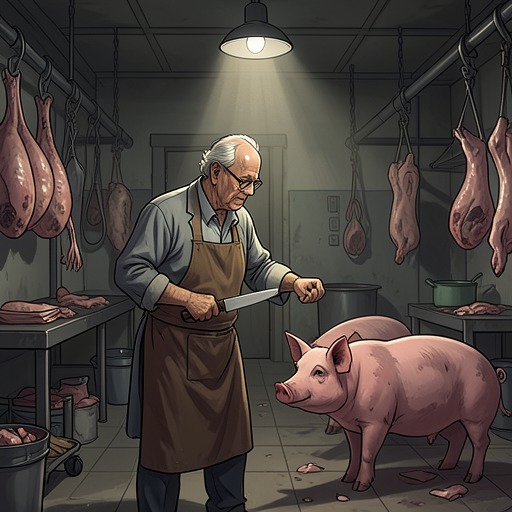
The family’s understanding of killing resists reducing butchery to brute force. Fidelis sees his father’s practiced work as a transformation: on the block, an animal’s creatureliness gives way to a more ordered form. The knife is central to that change, but the skill lies in the butcher’s knowledge of the animal’s bulk and grain and in the timing of each cut. Precision turns a necessary trade into an art.
This conception connects the knives’ material qualities to the novel’s larger attention to work and order. The blades are finely made, balanced tools, yet their value depends on a worker’s judgment and care. They must be clean, neither dull nor wastefully ground down, and kept ready for the demands of the craft. In that balance of preservation and use, Fidelis’s knives carry his family’s standards into his American life: inherited objects that remain useful because their owner continues to practice the knowledge they embody.